The short answer
There are four main types of loft conversion in the UK: Velux (rooflight), dormer, hip-to-gable and mansard. The right type for your home depends on your roof shape, the head height you already have and what your local planning authority permits. A Velux is the simplest and lowest-cost option; a mansard is the most extensive. See loft conversion costs to understand how type affects budget.
Choosing the wrong conversion type for your roof structure is one of the most common and costly mistakes in loft projects. A Velux conversion that looks perfect on a house with a generous ridge height will fail the head-height test on a shallower-pitched neighbour. A hip-to-gable that gains an extra room in a semi-detached house is not possible on a terrace. Understanding which type matches your roof — before you invite quotes — saves time, money and the disappointment of discovering limits late in the process.
Loft conversion types at a glance
- Simplest type Velux / rooflight — no roof shape change
- Most space gained Mansard — near-vertical walls both sides
- Semi-detached favourite Hip-to-gable — uses the hipped end
- Most common overall Rear dormer — permitted development on most rear slopes
- Planning free (usually) Velux and rear dormer within PD limits
- Always needs planning Mansard — major change to roof silhouette
Velux (rooflight) loft conversion
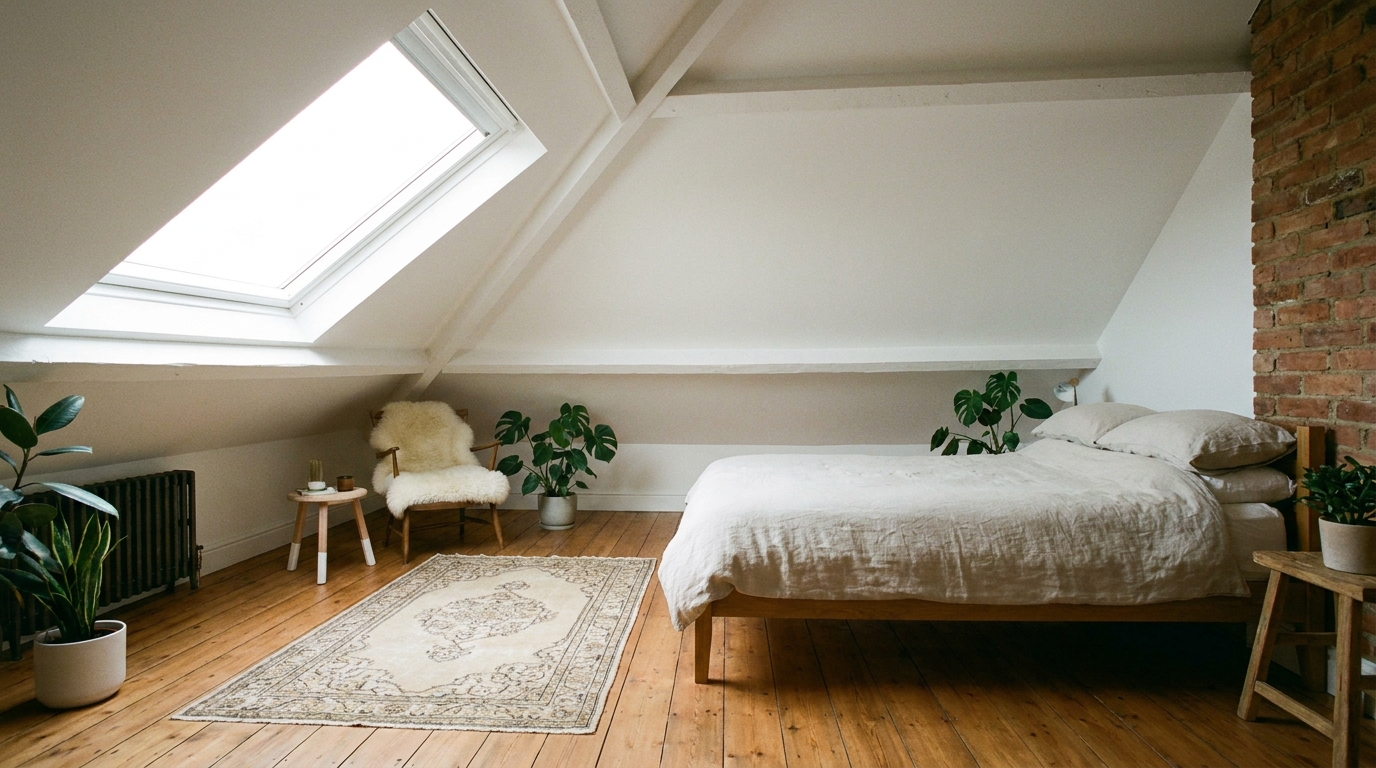
The Velux conversion — named after the best-known brand of roof window, though other brands exist — is the least invasive type. Skylights are cut into the existing roof slope, the floor joists are strengthened to carry the new room’s load, and insulation is fitted between and below the rafters. The external roof shape is unchanged: from the street the only visible difference is the roof windows. Because there is no volume addition, this type sits most comfortably within permitted development in England and rarely needs a planning application. It suits properties where the existing head height at the ridge already meets the 2.2 m building regulations minimum — typically a pre-1960 traditionally cut roof with a steep pitch. It is also the fastest and least disruptive option, with many projects completed in four to six weeks.
- Lowest cost: typically £20,000–£35,000.
- Best for: properties with sufficient existing head height, terraced houses, permitted development situations.
- Not suitable for: shallow-pitched roofs, modern trussed roofs without structural redesign.
Dormer loft conversion
A dormer is a box-shaped structure that projects vertically from the roof slope, with its own flat or pitched roof, creating a zone of full-height headroom within the new room. The rear dormer — running the full or nearly the full width of the rear slope — is by far the most common single conversion type in the UK, because it fits within permitted development rules on the rear of most terraced, semi-detached and detached homes when kept within the volume and height limits set out in the Town and Country Planning (General Permitted Development) (England) Order 2015. A front dormer almost always requires planning permission. L-shaped dormers, which wrap around a side return, are popular in Victorian and Edwardian terraces and add considerable space but may need planning permission.
| Dormer type | Planning | Space gained | Typical cost |
|---|---|---|---|
| Rear (full-width) | Usually PD | High | £30,000–£55,000 |
| Rear (partial) | Usually PD | Medium | £25,000–£45,000 |
| L-shaped (rear + side) | Often PD | Very high | £40,000–£65,000 |
| Front dormer | Usually required | High | £30,000–£55,000 |
Hip-to-gable loft conversion
Hip-to-gable conversions are specific to properties with a hipped roof — where one or both ends slope inward rather than meeting a vertical gable wall. In a semi-detached or end-of-terrace home, the hipped side-end can be rebuilt as a vertical gable, gaining a large triangular volume of new space. This is often combined with a rear dormer to maximise the new room’s usable area. On a detached property, both hip ends can be rebuilt to give an even larger gain. Because the external silhouette changes substantially, hip-to-gable projects typically require planning permission, and permitted development is less straightforward to claim. They also cost more than a straightforward dormer because of the structural work involved in rebuilding the hip end. See hip-to-gable loft conversion cost for typical figures.
Mansard loft conversion
The mansard is the most transformative of the four main types. One or both sides of the roof are rebuilt as near-vertical walls (typically 70–72 degrees from horizontal) topped by a shallow flat or low-pitched roof. The result is the maximum possible internal volume within the envelope of the house — a new full-height storey in effect. Mansards are most common in London and other cities with dense terraced housing, where their symmetrical appearance has become a familiar part of the urban roofscape. They almost always require planning permission because they fundamentally alter the appearance of the building, and they are the most expensive type. Materials, structural complexity and party wall considerations on a terraced property all push costs up. See dormer vs mansard for a direct comparison.
How to choose
The right type depends on four factors: your roof’s existing pitch and head height, the planning environment (permitted development vs application required), how much space you want and what you can spend. A structurally sound pre-1930s house with a steep pitch may suit a Velux at minimal cost. A 1970s semi with a shallow hipped roof needs a hip-to-gable or dormer combination. A London Victorian terrace where planning officers expect a mansard should follow the local precedent. An architect or specialist loft conversion company can assess your specific roof in the context of local planning policy. This page is general information, not professional planning or structural advice — always consult a qualified specialist before committing.
Frequently asked questions
Which type of loft conversion has the lowest cost?
A Velux (rooflight) conversion is typically the lowest-cost option, with most projects costing £20,000–£35,000. It suits roofs with sufficient existing head height and does not change the roof shape, so it usually falls within permitted development.
Which type adds the most space?
A mansard conversion adds the most internal volume, as it rebuilds the roof to near-vertical walls and maximises every square metre. A hip-to-gable combined with a rear dormer comes close and is often more achievable on semi-detached properties.
Can I do a loft conversion on a house with a trussed roof?
Yes, but it is more involved. Modern trussed roofs (post-1960s) cannot have their timbers cut without structural redesign. A structural engineer must design a replacement steel or timber frame — this adds cost but is done routinely.
Does a dormer always need planning permission?
Not always. A rear dormer that stays within the permitted development volume and height limits — and is not on a listed building or in a conservation area — can usually be built without a planning application. A front dormer or one that exceeds the limits will need permission.
Sources & further reading
- Planning Portal — permitted development for householder improvements, roof alterations volume limits
- LABC (Local Authority Building Control) — building regulations requirements for loft conversions
- GOV.UK — Town and Country Planning (General Permitted Development) (England) Order 2015
- RICS — guidance on loft conversions, added value and structural assessments
This is general information about loft conversions in the UK, not professional planning, structural, building or legal advice. Costs are typical illustrations, not quotes; timescales and outcomes vary with your property, location and chosen specialist. Always consult a qualified specialist and your local planning authority before starting work.